
This service is about investing and speculating in natural resources. However we do this in the context of the ideal portfolio. And that portfolio is based on a recession-proof model made popular by Artemis Capital and Chris Cole, it’s called the Dragon Portfolio. He published a paper called The Allegory of the Hawk and Serpent that explains this long term view of a portfolio.
The idea behind the Dragon Portfolio is to invest and speculate in such a way as to preserve your wealth regardless of market conditions, a portfolio that will stand the test of time, and last through generations. The allocations of such a portfolio will look roughly like the chart below.
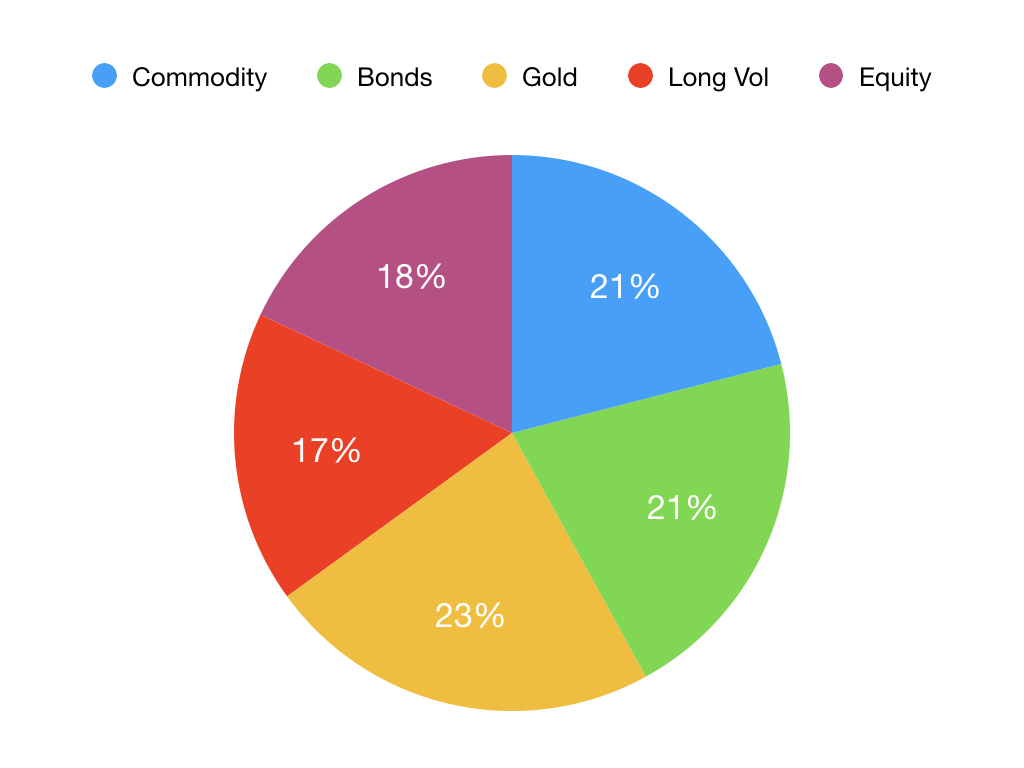
This represents the distribution of a test portfolio, so the categories are not equal, but roughly equal, and the data only goes back one year. The equity chart however is quite interesting, where in the face of this pandemic, the portfolio actually gains are significant.
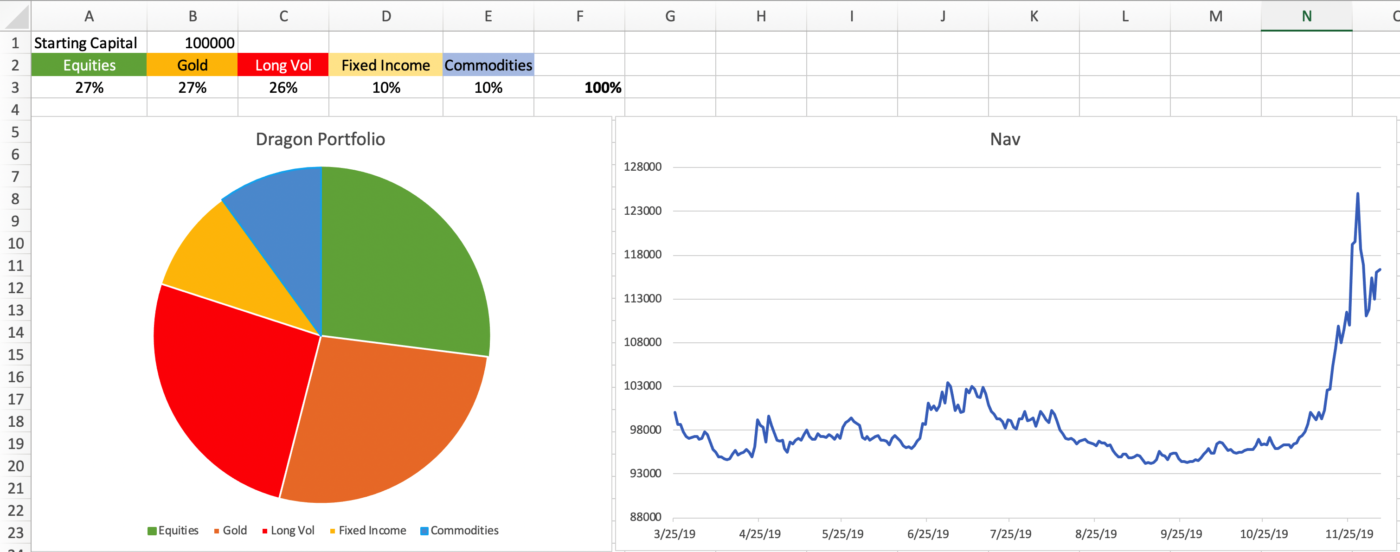
The allocations shown are my personal allocations. The portfolio standard is to have roughly equal amounts in each category of asset. There is no requirement to have exactly equal partitions.
Within each category you may have several investments and speculative plays. Now we can’t start with such a portfolio, in fact I’m starting with 77 percent cash and 23 percent gold. I expect to add to this portfolio over time by deploying my cash to eventually realize this Dragon Portfolio model. But this will take some time and will be conditional upon opportunities and what this economy delivers while we traverse this pandemic and economic situation.
In this advisory we will concentrate on the commodity, gold and equity parts of the portfolio first, then as the economic situation dictates, add to the Long Volatility and Bonds or fixed income. As we add positions we need to keep risk in mind based on the amount of capital we have allowed for investing and speculation. Here is the framework that I use.
Investment and Speculation
First of all I must state the obvious, that a speculation can become an investment, but an investment can never be a speculation. Let me explain…
An investment is something we hold for longer periods of time, we expect these to be companies that have revenues with real operating assets under their control, these assets produce free cash flow and a dividend. By contrast, a speculative play is a company that we expect is about to be acquired, or there will be some form of catalyst that will take the stock much higher. Now this speculative play may someday turn into an investment, for sure…and might become a great money maker with 10X or even 100X returns.
Capital Allocation
With each alert, we will identify whether we consider this a speculative or investment play. We will also recommend that the positions we take be split into tranches, so that we don’t commit everything in the first trade. This is because we can’t be certain that we are getting the best price, that we’re getting the exact bottom. In fact, we can assume that we will never get the exact bottom. And if we do, to will be by pure chance.
The number of tranches you create for each investment or speculative play will probably have most to do with the size of you total capital allocation. A small account will probably have fewer tranches, while a large portfolio will have more tranches. Maybe 2 or 3 for a small portfolio, and up to 5 or 6 for a large portfolio. This will allow you to get an overall better cost basis in the event that the price drops after the initial portion is taken.
Here are two rules for the total position size;
- Investment: Never use more than 10 percent of your total portfolio
- Speculation: Never use more than 5 percent of your total portfolio
So this means if your total portfolio is $100,000 , then your max position in any one investment will not exceed $10,000, and the max size of a speculative play will not exceed $5,000.
Articles that refer to an investment and speculation play will be categorized as such, and I will make it clear in the first paragraph which type of play it is.
Another general rule that I use in each category of the Dragon Portfolio, is that two thirds is allocated investment, and one third is allocated as speculative. This is only for my resource plays, the type of plays we will be talking about in this advisory.
AA Watchlist
Currently we have Gold Standard Ventures (GSV) as our primary speculative play. Following are the investment and speculative plays that we either have positions or are on our watchlist to acquire. And quite frankly, virtually all of these are candidates for picking up in this economic downturn. They are listed in order of preference or value, top of the list are more preferable.
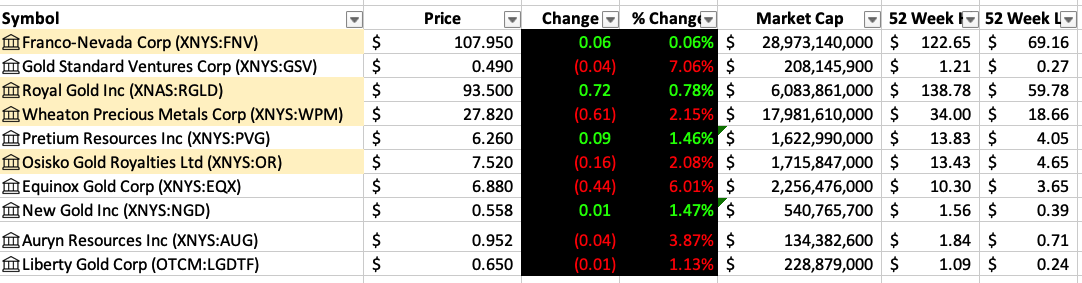

Why are some highlighted on the list?
Those are stocks we write calls against.
Is there a way you can identify what is speculation and what is an investment stock, that way we know how much cash to commit.
Yes, I will identify it in the category of the post and mention it in the content of the post.
Can you create a tab (AA watchlist), it would be very easy to navigate to.
Good suggestion. When we get enough assets to watch I will implement that.